A process improvement project helps you:
- Identify what’s causing delays or frustration
- Remove unnecessary steps and reduce manual effort
- Improve accuracy and reduce errors
- Provide a better experience for students, faculty, and staff
Every department has processes that could run more efficiently—whether it’s reducing delays, simplifying forms, or improving communication. Our team is here to help you discover what steps are slowing things down and partner with you to design solutions that make your work easier, faster, and more consistent.
Getting started is simple:
- Tell us about your process. Share the challenge you’re experiencing or the workflow you would like to improve.
- Meet with our team. We will learn about your goals and determine whether a Lean Six Sigma project is the best fit.
- Join us in creating a better process. Together, we will map, analyze, and improve your workflow to support better service and greater efficiency.
You don’t need to have all the answers—just a willingness to explore what’s possible. Contact our team to begin your process improvement journey!
Process Improvement FAQ
The Process Improvement Service helps campus departments analyze and improve how work is performed. The service focuses on streamlining workflows, reducing inefficiencies, improving consistency, and enhancing service delivery for students, faculty, and staff.
This service is best suited for administrative, operational, and student-facing processes, particularly those that involve multiple steps, handoffs, or departments and where improvements to clarity, efficiency, or quality are desired.
The service does not make policy decisions, resolve personnel matters, or independently select or procure technology. While technology tools may be used to support process improvement, the focus remains on improving the underlying process.
No. This is a collaborative, facilitative service. It is not an audit, evaluation of individual performance, or compliance investigation.
Projects typically use Lean Six Sigma principles and other continuous improvement
techniques to identify root causes, reduce inefficiencies, and design sustainable
improvements.
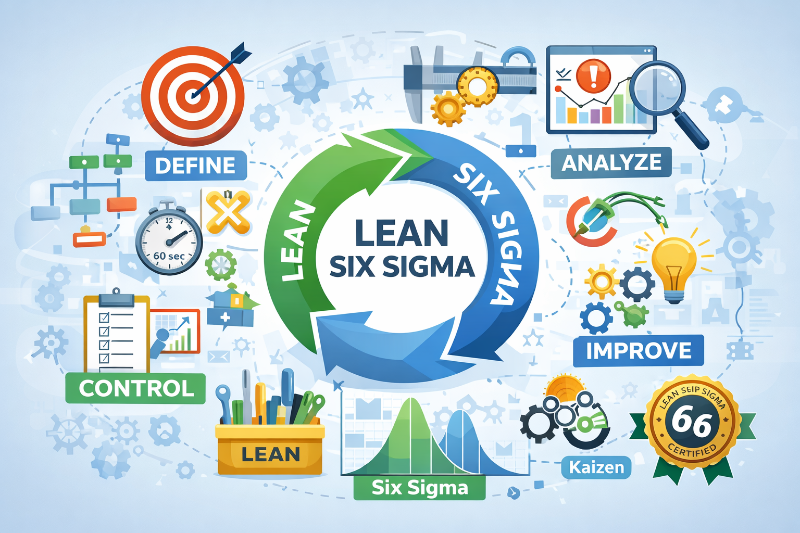
A typical Lean Six Sigma process improvement project includes:
- Define the Problem - We work with your department to understand the problem, clarify goals, and identify what “better” looks like. This ensures the project focuses on what matters most to your team and your stakeholders.
- Map the Current Process - We document how the process actually works today—not how we think it works. This step often reveals hidden steps, bottlenecks, inconsistencies, and opportunities for improvement.
- Analyze the Root Causes - Using Lean Six Sigma tools, we identify the real sources of delays, errors, and inefficiencies.
- Improve the Process - We partner with your team to design practical, achievable improvements. These may includereducing handoffs, clarifying roles, simplifying forms, automating tasks, or standardizing workflows.
- Implement and Test - Your team tries out the new process, and we help ensure it works smoothly. Adjustments are made as needed to ensure long-term success.
- Sustain and Monitor - We help develop documentation, metrics, and feedback loops so your department can maintain improvements over time.
Depending on the needs of the project, the team may facilitate process improvement using tools such as Smartsheet, Kuali Build, and approved artificial intelligence technologies. These tools may be used to support workflow mapping, data collection, automation, analysis, or documentation.
Not necessarily. The use of tools is determined collaboratively and is intended to support process improvement. Any recommendations involving new or expanded use of technology are subject to appropriate governance, review, and approval processes.
Yes. Successful projects require an identified department head or executive sponsor who supports the effort, ensures participants can allocate time to the project, and helps approve and implement recommended changes.
Departments submit a request through a standard intake process describing the process challenge, desired outcomes, and impacted stakeholders. The Business Process and Transformation team will review the request and follow up as appropriate.
Requests are reviewed and prioritized based on factors such as impact, complexity, cross-departmental involvement, and available capacity. Not all requests may be accepted or scheduled immediately.
Departments should expect to participate actively through working sessions, data validation, and feedback. Staff who perform the work are typically involved to ensure practical and sustainable solutions.
Project duration varies based on scope and complexity. Most engagements range from several weeks to a few months.
Outcomes may include clearer roles and responsibilities, reduced cycle times, fewer handoffs, improved consistency, reduced rework, and a better experience for those who rely on the process.
The service supports institutional goals related to student success, operational effectiveness, compliance and risk reduction, digital transformation, and responsible use of resources by improving how work is performed across campus.